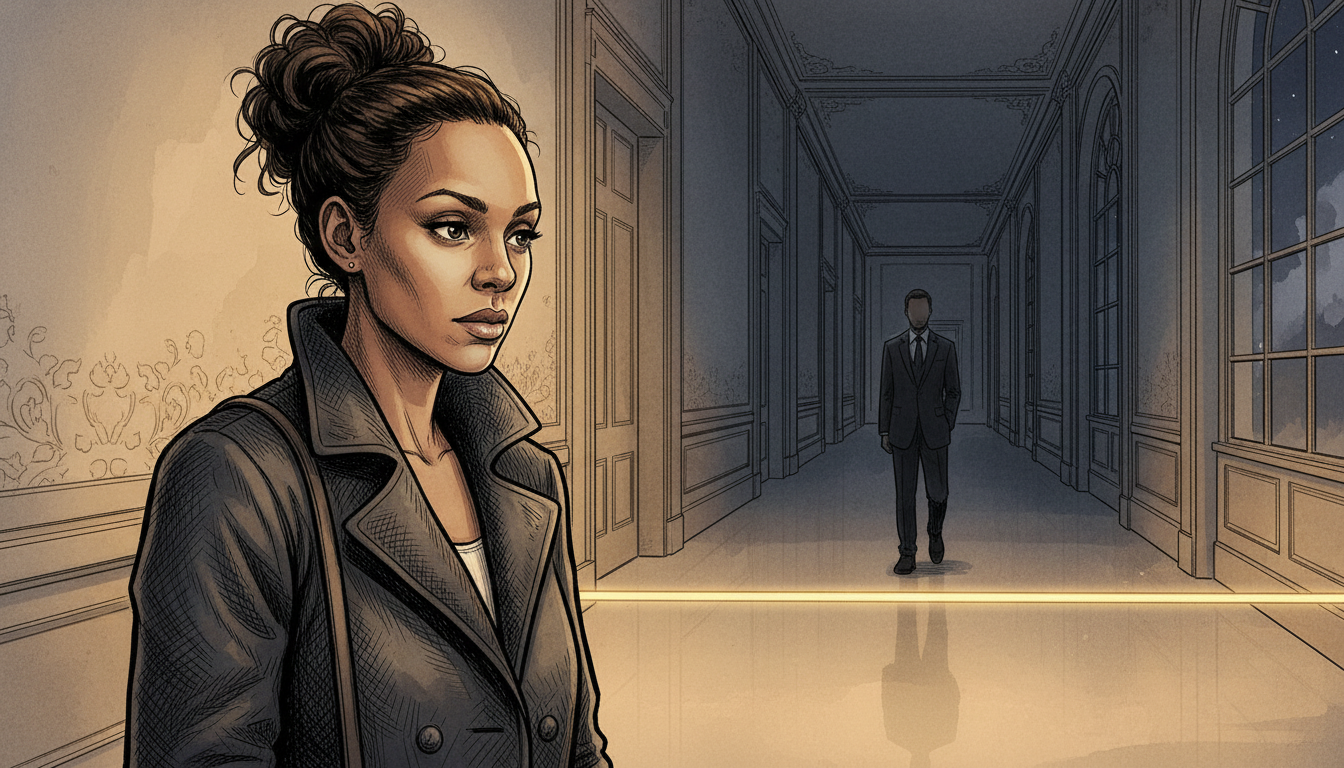
As a society, we agree on lines. The line between right and wrong. What is acceptable to do, and what is not.
We agree on them so completely that we stop seeing them. These lines are invisible, and they hold up almost everything.
What is the invisible line?
It is the shared agreement that some things are not done, and the belief that people won't do them.
As women, we rely on it every day. We get into a taxi and trust the driver won't take us somewhere we didn't ask to go. We go to a man's home and trust he won't do anything we don't want. Nobody has promised us that. We trust it because doing otherwise would be crossing the line, and people don't cross the line.
Shops rely on the same thing. Most people don't walk out with goods they haven't paid for. Nobody needs to stand guard. The line does that job.
Why does it matter so much to women?
Women are physically weaker, so a great deal of our safety rests on other people's lines.
When I was 16, I went to the home of a man who was about 30. He wanted more, and he pushed, and he tried. But in the end, he did not cross the line.
I didn't know it then, but I wasn't safe because of anything I did. I was safe because he had the line inside him and abided by it.
We walk into situations believing the line exists. For most people, it does. For some, it doesn't. That is when we stop being safe.
What happens when the line is broken?
When a woman is attacked, raped or molested, part of the damage is this: she loses her trust in the invisible lines.
Without faith in those lines, anything can be anything. You don't feel safe in the taxi. You don't feel safe going to someone's house.
Your innocence has been snatched away, because now you know the lines can be broken at will. Life comes down to survival of the strongest.
So you become hypervigilant. You over-prepare and stop taking risks. And possibility and expansion drain out of a woman's life.
Where do our lines come from?
We don't invent our lines. We are given them, mostly by our parents.
Parents create reality for their children. If I told my one-year-old she would one day be able to fly, she would spend her childhood checking for wings. A child doesn't question the world she is shown. She takes it as how things are.
So when a parent shows a child a world where the lines can be crossed, that lesson goes in deep, before the child is old enough to question it. Rebuilding those lines later is very hard. Not impossible. But hard.
I know this from my own family. I watched my mother coerce her children into crossing lines they should never have crossed, and I have seen the consequences for a lifetime. When the parent is the one breaking the lines, there is nothing for the child to push against.
What does Russell Brand's story show?
Russell Brand has been convicted of rape and sexual assault and sentenced to ten and a half years in prison. He is responsible for what he did. Nothing here changes that.
But look at what he has told us, in his own words, about how his line was broken.
In his 2007 memoir, My Booky Wook, Brand describes a holiday in Hong Kong with his father when he was 17. His father paid for sex workers, for himself and for his son. Brand wrote that for the rest of that holiday he slept with "loads more prostitutes and never wore a condom". He also wrote that his sexuality "had morphed forever from bewildered innocence into something more complex and rapacious".
Those are his words. In my opinion, a father took his teenage son to the line, and over it, again and again.
Why do we find people with no line so watchable?
Then we watched the result on television. A man on chat shows touching a guest's leg, saying what no one else would say, doing what no one else would do.
It was enthralling. Almost hypnotic. It felt like a kind of sorcery: how can he cross the line as if it isn't there?
Most of us couldn't do that if we tried. The lines are part of us, because our parents kept to them, and so did the society that raised us.
So we watched a man who had no line, and we rewarded him for it, because it was entertaining.
That may also be why we keep hearing about entertainers crossing lines in their private lives. What makes someone thrilling to watch can be the very thing that lets them cross it.
Who is responsible?
I am not arguing that the man who crossed the line should be held less responsible. He made his choices, and a court has judged them.
I am arguing that we should also look at the person who broke the line for him first.
Responsibility isn't a fixed amount to be shared out. Brand carries all of his. His father carries all of his. Everyone involved can be fully responsible.
We already have the beginnings of this in law. Coercive control and grooming are crimes because we accept that one person can shape and drive another's behaviour. Where there is a direct connection between one person's coercion and another person's crime, I believe that coercion deserves to be examined too.
We can no longer deny the effect of childhood on the adult. If we want a society that works, we have to stop just cutting off the bad plants, and clean the soil too.
Can you rebuild a line you were never given?
Yes. If you grew up in a home where the lines were blurred, or broken on purpose, that isn't your fault. It is also not your destiny.
My mum told me food on the shop floor was free. I still never stole.
It's entirely possible to hold a line you were never given.
Lines can be rebuilt as adults. It takes deliberate work: noticing where yours are missing, and putting them back, one by one. Its harder than being given them as a child. It matters, for you and for everyone who walks into a room trusting the line is there.
Inner child work was one of the ways I healed my own childhood. The free resource is at theshift.one/inner-child.